

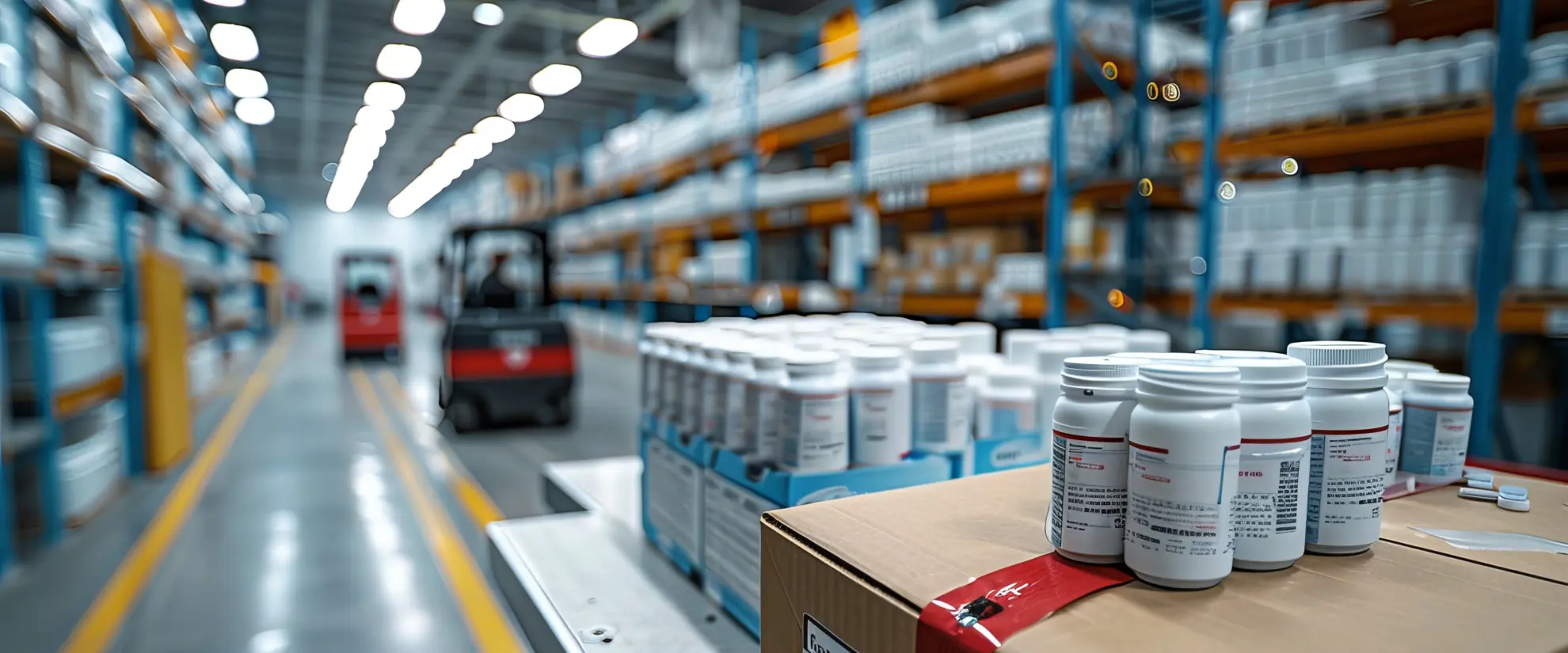
How Pharmaceutical Logistics Supports GMP Compliance and Audit Readiness
Pharmaceutical logistics serves as the operational layer responsible for maintaining Good Manufacturing Practices (GMP) compliance during distribution. It carries controlled manufacturing requirements into storage, handling, and transportation, where product integrity must be preserved under real-world conditions.
Compliance at this stage depends on maintaining validated environmental controls, standardized handling processes, and complete, traceable documentation. When these controls are not maintained, products can become non-compliant regardless of manufacturing quality. Maintaining the necessary level of control requires coordinated processes, systems, and execution discipline across the logistics function, all of which contribute directly to regulatory compliance and audit readiness.
What is Pharmaceutical Logistics?
Pharmaceutical logistics comprises the coordinated system of activities that manages the physical flow of pharmaceutical products through the supply chain, from sourcing and manufacturing support through warehousing, distribution, and final delivery. It encompasses the operational movement and control of pharmaceutical materials as they transition between manufacturers, distribution centers, and end users. This includes the planning and execution of procurement, inventory management, storage operations, transportation coordination, and delivery scheduling across complex and often global networks. Pharmaceutical logistics is often supported through outsourced business process models, where third-party providers manage regulated supply chain operations at scale.
Unlike general logistics functions, pharmaceutical logistics operates within highly structured supply chains where product characteristics, handling requirements, and distribution routes vary based on formulation, packaging, and destination. As a result, it requires tightly coordinated workflows across multiple stakeholders, including manufacturers, third-party logistics providers, distributors, and healthcare facilities.
The scope of pharmaceutical logistics also extends beyond physical transportation to include the orchestration of information and material flow. This includes inventory visibility across multiple nodes, coordination between systems and partners, and alignment of logistics activities with downstream demand in healthcare and clinical environments. In practice, pharmaceutical logistics functions as the operational framework that connects production output with patient delivery, ensuring that pharmaceutical products move through the supply chain in a controlled, structured, and traceable manner.
Critical Regulatory Requirements for Pharmaceutical Logistics
A set of overlapping regulatory frameworks governs pharmaceutical logistics and defines how products are controlled across supply chain operations. These requirements establish the minimum conditions for maintaining product quality, ensuring traceability, and protecting patient safety throughout distribution activities.
Good Distribution Practice (GDP)
Defined as the baseline requirements for maintaining product quality throughout the distribution phase, GDP establishes controls for environmental conditions (such as temperature, humidity, and light exposure) during storage and transport. GDP requires documented procedures for product movement activities, including receiving, dispatch, and transfer. It also defines expectations for the qualification and oversight of logistics providers, along with the ability to maintain end-to-end product traceability across the distribution network.
Good Manufacturing Practice (GMP) as it Applies to Logistics
While GMP is primarily associated with manufacturing, its requirements extend into logistics to ensure product integrity preservation beyond production. This includes controlled storage of raw materials and finished goods, segregation of inventory based on status, and strict inventory management practices such as First In, First Out (FIFO) or First Expired, First Out (FEFO). GMP further requires complete, accurate, and retrievable records that support full product history verification throughout the supply chain.
Serialization and Track-and-Trace Requirements
Serialization and track-and-trace regulations establish product-level visibility and security across the pharmaceutical supply chain. Frameworks such as the Drug Supply Chain Security Act (DSCSA) require unique product identifiers, standardized electronic data exchange between supply chain partners, and verification at key points of distribution. These requirements are designed to prevent counterfeit entry, strengthen supply chain integrity, and enable rapid identification and removal of affected products.
Regulatory Oversight and Regional Requirements
In addition to global frameworks, pharmaceutical logistics must comply with region-specific regulatory expectations enforced by authorities such as the U.S. Food and Drug Administration (FDA) and international regulatory bodies. These requirements address controlled storage conditions, sanitation and facility standards, documentation practices, and recall preparedness. Across all jurisdictions, the core expectation remains consistent: pharmaceutical logistics must demonstrate controlled execution, complete traceability, and rapid responsiveness to quality events.
Ensuring Regulatory Compliance and Audit Readiness in Pharmaceutical Logistics
Pharmaceutical logistics ensures regulatory compliance and audit readiness by translating regulatory requirements into controlled, repeatable operational execution across the supply chain. Compliance is not achieved through documentation alone but through the consistent application of standardized processes, system-based controls, and real-time data capture at every stage of product movement. This creates a continuous chain of verifiable activity that supports both regulatory expectations and inspection requirements.
Documentation
Pharmaceutical logistics generates compliance-grade documentation through structured execution activities across the warehouse and distribution environment. Every product movement is recorded as part of defined workflows, ensuring that records are created contemporaneously rather than reconstructed after the fact. The result is a complete, retrievable record set that reflects end-to-end product movement and supports regulatory verification requirements.
Receiving, put-away, transfers, picking, and shipping activities produce batch-level and transaction-level records that support full product traceability. These records are maintained through integrated systems such as Warehouse Management System (WMS) and Enterprise Resource Planning (ERP) platforms, enabling consistent audit trails across the supply chain. Documentation also includes handling logs, inventory records, and the distribution of confirmations, which collectively support inspection readiness.
Real-Time Tracking
Real-time tracking ensures continuous visibility into product status, location, and condition throughout the logistics lifecycle. This visibility is maintained through system-driven updates generated at each stage of execution, including storage, movement, and distribution activities.
Warehouse and logistics systems continuously capture inventory location changes, while environmental monitoring tools track temperature and condition thresholds during storage and transport. These data streams are integrated across platforms to provide a unified view of product movement across the supply chain. Real-time tracking enables immediate identification of deviations and supports rapid decision-making, ensuring that compliance is maintained during active operations, rather than confirmed after completion.
Lot/Batch Control
Lot and batch control ensure that product identity is maintained from one end of the supply chain to the other. Each product is tracked at the batch or serial level from receipt through final distribution, ensuring accurate segregation and traceability at all times.
These controls also support broader pharmaceutical materials management strategies by improving inventory visibility, reducing handling errors, and strengthening traceability across regulated warehouse operations.
Inventory management processes enforce controlled movement of materials through defined rules such as FIFO or FEFO, preventing mixing, misidentification, or incorrect selection. Batch-level controls are embedded into receiving, storage, put-away, picking, transfer, and shipping activities. This ensures that every unit of product can be traced back to its origin and verified throughout its lifecycle.
Chain of Custody
Chain of custody establishes documented accountability for product movement across every transition point in the supply chain. Each handoff between locations, systems, or logistics partners is recorded and verified through structured workflows. This structure supports regulatory expectations for traceability and provides defensible evidence during inspections and audits.
Receiving initiates custody records, internal transfers maintain continuity, and final shipment transfers confirm release to downstream partners or carriers. These records are maintained within integrated logistics systems, ensuring a continuous and auditable chain of responsibility.
Exception Management
Exception management ensures that deviations from standard operating conditions are identified, recorded, and resolved in a controlled manner. Common exceptions include temperature excursions, handling errors, inventory discrepancies, or transportation delays.
When deviations occur, they are immediately captured within system workflows and escalated through defined Corrective and Preventive Action (CAPA) processes. This response enables structured investigation, documentation, and corrective action aligned with regulatory expectations. Exception management also plays a critical role in recall readiness by enabling rapid identification of affected products and supporting efficient removal from the supply chain when necessary.
Pharmaceutical Logistics vs. General Logistics
Pharmaceutical logistics requires validated environments, controlled workflows, product traceability, and regulatory compliance throughout storage and distribution activities. General logistics operations are typically optimized around transportation efficiency, delivery speed, and cost reduction rather than GMP-controlled execution. Pharmaceutical organizations often require specialized logistics providers with experience managing regulated inventory, audit-ready documentation, environmental monitoring, and serialization requirements.
How Canon Business Process Services Ensures GMP Compliance
Canon Business Process Services ensures GMP-compliant pharmaceutical logistics by embedding visibility, standardization, and real-time execution controls directly into daily supply chain operations. Instead of treating compliance as a reporting function, Canon operationalizes it at the point of execution, where materials are received, processed, moved, and shipped. This approach creates a controlled environment where every transaction produces traceable, audit-ready outcomes.
Embedded Compliance in Daily Logistics Execution
Canon integrates GMP requirements directly into warehouse and distribution workflows, ensuring that compliance is built into execution rather than layered on after the fact. Operational processes are configured so that regulatory requirements are reflected at the point of activity. This embedded approach ensures that compliance is continuously maintained throughout operational execution rather than recreated for audit purposes.
Receiving is directly linked to purchase order validation and ERP confirmation, ensuring product intake is verified at entry. Inventory movements are captured at the moment they occur, creating real-time transaction records. Shipping and transfer activities automatically generate traceable documentation, while exceptions are logged immediately within system workflows instead of being reconstructed retrospectively.
End-to-End Supply Chain Visibility
By providing continuous visibility across all stages of the pharmaceutical supply chain, Canon ensures that product movement is fully observable, from inbound receipt through final distribution. This creates a fully traceable flow of materials, ensuring no product movement occurs outside of documented control.
Receiving processes provide inspection and intake visibility, while storage activities maintain real-time tracking of location and environmental conditions. Movement events such as replenishment, picking, and transfers are recorded within integrated systems. Outbound distribution is supported through shipment tracking and confirmation processes.
Data Integrity at the Point of Activity
Canon strengthens GMP data integrity by capturing compliance-relevant information at the exact moment operational tasks are performed, reducing reliance on manual reconciliation and post-event data correction. The result is a high-integrity data foundation that supports reliable audit preparation and regulatory review.
Purchase order-level validation processes eliminate blind receiving, while system-driven execution within warehouse platforms reduces manual entry errors. By aligning physical product movement with ERP and warehouse management systems, we ensure consistency between operational activity and system records. These controls support adherence to ALCOA+ data integrity principles across the logistics environment.
Standardized Execution Across Sites
Implementing standardized workflows across facilities, teams, and operational sites reduces operational variability in GMP-controlled settings. Canon delivers predictable compliance performance and improved operational consistency at scale. We standardize receiving and handling procedures and apply tracking and documentation practices uniformly across operations. These repeatable processes reduce dependency on individual operator interpretation and help ensure consistent execution across multi-site networks.
End-to-End Ownership of GMP Deviations and CAPAs
In pharmaceutical manufacturing, where regulatory expectations are uncompromising and the cost of quality failure is significant, the ability to effectively manage deviations/non-conformance events is a critical differentiator. Canon stands apart by offering experienced GMP professionals who don’t just support investigations: they take full ownership of non-conformance records from initiation through closure. This end-to-end accountability ensures consistency, technical rigor, and compliance at every stage, from root cause analysis to CAPAs and final quality assurance approval.
Continuous monitoring and system-based alerts enable real-time identification and management of operational deviations. With the help of our experts, companies can detect exceptions during execution rather than after completion, reducing the delay between issue occurrence and response.
Temperature excursions, handling deviations, and inventory mismatches get flagged immediately within operational systems. Non-conformances enter the log in real time and route through structured escalation workflows, including CAPA processes where required. This methodology reduces compliance risk, improves response time, and strengthens control over quality-related events within logistics operations.
Unlike many service providers who rely on fragmented support models or junior resources, our team brings deep, hands-on experience within regulated environments, enabling faster resolution timelines, higher-quality documentation, and stronger audit readiness. This level of ownership is a rare and valuable capability in the industry, providing our clients with confidence that complex quality events are being managed by experts who understand both the science and the regulatory landscape.
Operational Outcomes and Proof Points
Canon Business Process Services’ visibility-driven execution model produces measurable improvements across compliance performance, workforce stability, and outbound logistics performance:
- Operational deviations were reduced by 33.8%, reflecting stronger control over GMP execution and a corresponding reduction in compliance risk, CAPA workload, and regulatory exposure within regulated environments.
- At the same time, workforce stability improved as attrition declined from 43.5% to 33.8%, resulting in a more experienced, GMP-trained workforce and fewer disruptions caused by retraining, qualification gaps, or knowledge loss.
- These operational gains also translated into improved supply chain performance, with shipments increasing by 12.9%, strengthening on-time, in-full delivery rates and improving the predictability of downstream distribution and commercialization timelines.
Taken together, these results show how embedding visibility and execution control into pharmaceutical logistics directly drives measurable gains in GMP compliance, workforce stability, and supply chain reliability.
Ready to Strengthen Your Pharmaceutical Logistics Operations?
Pharmaceutical logistics is where GMP compliance is continuously maintained, validated, and proven. While regulatory frameworks define the requirements, it is execution, supported by visibility, standardized processes, and real-time data, that determines whether those requirements are consistently met. Organizations that embed these capabilities into their logistics operations move beyond reactive compliance and into continuous audit readiness.
Canon Business Process Services helps pharmaceutical organizations operationalize this level of control, delivering the visibility and execution discipline required to maintain compliance at scale. Contact our team today to learn how Canon can support your logistics operations.